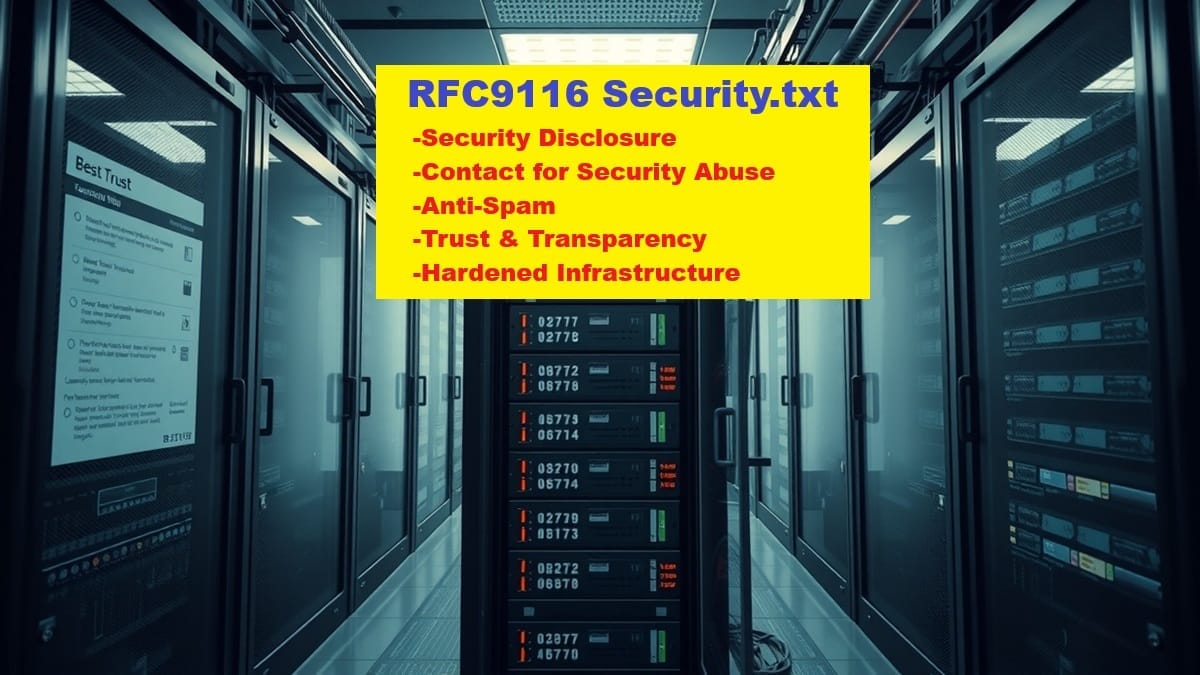
This checklist enables security.txt (RFC 9116) on a DirectAdmin VPS. This is a one‑time, server‑level configuration that applies to the DirectAdmin user framework and automatically extends to all current and future domains.
Although this step is often performed after initial domain and mail setup, it only requires the Account Domain to be in place and can be applied at any time thereafter. Administrators are rarely “finished” adding or modifying domains, and enabling security.txt early ensures consistent disclosure coverage without waiting for domain work to be complete.
Scope and sequencing
- Performed once per DirectAdmin VPS.
- Automatically extends to all current and future domains.
- Requires DirectAdmin admin‑level access.
If domain DNS, SSL, or mail authentication is still in progress, stop and complete those steps first.
Enable security.txt for DirectAdmin users
- Log in to DirectAdmin as admin.
- Navigate to Account Manager → My Users.
- On the right pane, click Modify Your Own User Data.
- Under Change Package, set the package to the appropriate user package.
- This ensures the setting applies only to that user package.
- On single‑user‑package licenses, this option is disabled by design.
- Under Change IP, set the IP to the applicable server package.
- This ensures the setting applies to the licensed server.
- On single‑server licenses, this option is disabled by design.
- Scroll to the Manually Change Settings section.
- Set Automatic security.txt (RFC 9116) to Enabled.
- Click Save.
Verify security.txt status
- From DirectAdmin, go to Server Manager → Security.txt Report.
- Confirm all domains show valid status (green check marks).
Validation is applied per domain and typically completes within 1–3 minutes per domain.
Public availability confirmation
The security.txt file is publicly accessible on every hosted domain at:
https://<any-domain>/.well-known/security.txt
Operational notes
- No per‑domain configuration is required.
- No application‑level files are created or managed.
- Future domains inherit this automatically.
Next step:
• Install Softaculous (optionally)
• If not done yet, create VPS System Backup (one-time safety checkpoint)
• If additional domains are planned, continue with adding another domain to the DirectAdmin VPS.
• Otherwise, transition into Maintenance & Operations for ongoing server management.